Pages

Friday, September 06, 2013

Early Black British

People in Britain of African descent generally refer to themselves as Black British. This includes people from former British colonies in Africa and Afro-Caribbeans. However, Africans appeared in Britain long before the British colonized Africa. The first Blacks in Britain arrived as soldiers in the Roman armies in the 2nd and 3rd centuries AD. They rebuilt and were stationed along Hadrian's Wall. They were under the rule of Septimus Severus, a Black Roman Emperor based in York.

Severus Septimus, ruled AD 193-211
Archaeological finds also indicate that there were other African people in the upper echelons of society at that time. A Roman grave found in York contains a skull of a Black or mixed-race woman. Her sarcophagus was made of stone and also contained a jet bracelet and ivory bangle, both indicators of great wealth at that time. Later, the Vikings raided the north coast of Africa, taking people as slaves to Ireland and Britain.


There are numerous instances of interest and surprise to be found in the history of Black Britons. Queen Phillipa (b.1313, Belgium) was married to the future King Edward III and descriptions of her indicate African ancestry. Their son was known as the Black Prince, a reference to his appearance.

 Africans arrived in Britain in the 16th century in the entourage of Catherine of Aragon. An illuminated manuscript from 1511 shows a black trumpeter in the retinue of King Henry VIII.


Manuscript 1511


The increase in trade between London and West Africa resulted in the growth in the population of Africans. The first recorded Black resident was in 1593, a man named Cornelius. Another influx of Africans occurred in the 17th century when people were freed from Spanish slave ships.

Portrait, Queen Charlotte, 1762
There is currently much discussion among historians of the African ancestry of Queen Charlotte, consort of King George III (1738-1820), after whom Charlotte, North Carolina is named.

The slave trade and its subsequent abolition in Britain resulted in the arrival of more Africans in the 17th and 18th centuries. For more readings on Black history in Britain, see the link to the website The Black Presence in Britain.

Two museums in Britain dealing with some of the history of Blacks in Britain can be found at this link.

Friday, August 09, 2013

The Geography of Landmarks

BlackPast.org recently launched a new section called National African American Historic Landmarks. These landmarks have been certified by the National Park Service and are organized by state. As you peruse this list and notice any omissions, please let us know.

Buffalo Soldiers, 25th Infantry, Fort Keough, Montana 1890
There two other aspects of the National Park Service that require us all to pay attention. First, from the very inception of the National Park Service, and the difficulties in getting it established (much attention is paid to this in the excellent book The Big Burn:Teddy Roosevelt and the Saving of America by Tim Egan, purchasing it here benefits BlackPast.org), African Americans have been closely associated with its success. Buffalo Soldiers, like their white counterparts, were among the first park and back country rangers in the years following the Civil War, as rangers were an outgrowth of the military.  Colonel Charles Young (died 1923), the third African American graduate of West Point, is considered by many to be the first African American Superintendent of a National Park. For more great photos of African Americans in the National Park Service, click on this link.
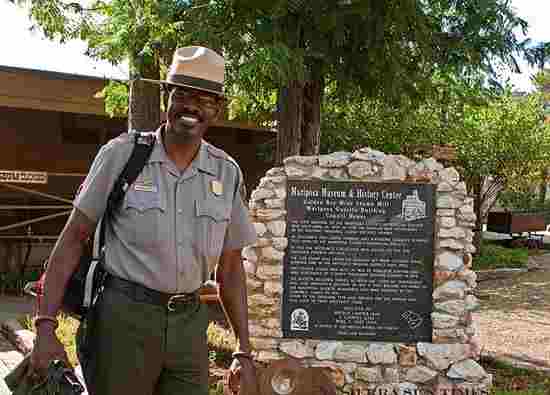
Yosemite Ranger Shelton Johnson, 2011, Mariposa Museum

Second, there has been concern by National Park Service administrators and by African American Rangers regarding the low numbers of various ethnic groups, particularly African Americans, as visitors to National Parks. In surveys done by the National Park Service, a significant number of respondents said they felt unwelcome in many parks and felt that safety was an issue. The Park Service is making attempts to redress this situation. One outcome has been the certification of African American Landmarks, mentioned at the top of this post. Outreach by Rangers such as Shelton Johnson is also part of this effort.

A related concern is the low number of African Americans in the sciences in general and environmental sciences in particular. By engaging youth in such places as the Martin Luther King, Jr. Memorial with young, enthusiastic Rangers, it is hoped that more people will feel an excitement that will translate into a career worth pursuing as well as encouraging their families to visit more National Park sites.
Rangers at the MLK Memorial

Wednesday, July 17, 2013

African Americans Abroad

African Americans have a long history of serving their country in the Foreign Service. The following is a list of 'firsts': this list is by no means exhaustive and presents many people not commonly discussed.

The first such individual was William A. Leidesdorff, who was appointed in 1845 as Vice Consul at Yerba Buena (now San Francisco), when California was part of Mexico. In 1869, President Ulysses S. Grant appointed Yale graduate Ebenezer Don Carlos Bassett as Minister Resident and Consul General in Haiti. From this point on through the 1930s, African Americans served as minisers, consuls, and other officials in Latin America, Europe, Africa, and Asia. These officials included such luminaries as Frederick Douglass, James Weldon Johnson, Archibald Grimke, Richard T. Greener, George Washington Ellis, and Henry Francis Downing.

Edward R. Dudley, 1911-2005
Lester Aglar Walton can be considered the first African American Ambassador, even though his title did not officially use that term. He was appointed by President Franklin D. Roosevelt as envoy extraordinary and minister plenipotentiary to Liberia in 1935. His successor, Edward R. Dudley, was appointed Minister to Liberia in 1948 and promoted to Ambassador to Liberia in 1949, thus becoming the first African American to officially hold the title of Ambassador.

The first African American woman to hold the post of Ambassador was Patricia Harris. She was appointed by President Lyndon Johnson as Ambassador to Luxembourg from 1965-1967. Ruth A. Davis is the first African American woman to be promoted to the rank of Career Ambassador, the highest rank in the
Ruth A. Davis
Foreign Service. Ambassador Davis joined the Foreign Service in 1969 and served her country during the Clinton Administrations.

James Carter and William Yerby were the first African Americans to enter the regular career Foreign Service. Their colleague, Clifton Reginald Wharton Sr. joined the Foreign Service in 1925. He became the first African American Foreign Service Officer to become chief of a diplomatic mission to a European country when he was appointed Minister to Romania in 1958 and served until 1960. He subsequently served as Ambassador to Norway from 1961-1964. His son Clifton R. Wharton, Jr. was the first African American to hold the number two position in the State Department as Deputy Secretary of State, 1973.

Dr. LaRae Washington Kemp was the first African American Medical Director, serving as Assistant Secretary of the Department of State for Health Affairs and Medical Director for the U.S State Department and Foreign Service (1991-1994). The first African American Civil Service employee to serve as an Ambassador is Barry L.Wells, who was appointed as Ambassador to the Republic of The Gambia in 2007.

The first African American Secretary of State was Colin Powell, appointed by President George W. Bush in 2001. The first African American woman to be Secretary of State was Condoleezza Rice, appointed in 2005 by President George W. Bush. Barbara M. Watson had a distinguished career in the Foreign Service, starting as Administrator of the Bureau of Security and Consular Affairs in 1968. In 1977, she became Assistant Secretary of State for Consular Affairs and served until 1980. She was the first woman to hold the title of Assistant Secretary. She also served as Ambassador to Malaysia, 1980-81.

Edith S. Sampson
Andrew Young is trumpeted as the first African American Ambassador to the United Nations, appointed by President Jimmy Carter in 1977. However, Edith S. Sampson was an African American diplomat who was appointed by President Harry Truman as an alternate U.S. delegate to the United Nations in 1950, thus making her the first African American to be hold this position.

The final entry for this discussion is Pamela Spratlen, Ambassador to the Kyrgyz Republic. BlackPast.org is proud to list her as a contributor to the website. For individuals wishing to peruse a longer list of African Americans in the Foreign Service, the information can be found at the U.S State Department History Archives, some of which is compiled here.

Monday, July 01, 2013

Armchair Travel 2013

The debut post for BlackPast.org Blog was July 1, 2012. Happy Anniversary! There has been a variety of topics covered, some more popular than others, thoughtful comments, and positive feedback.

Last August, one of the posts (Thinking of Travel: Armchair and Otherwise) explored how to get the most out of travel planning by using fiction to get ideas, learn about a place, or get lost in imagining a vacation in a place and culture whose physical geography may be out of reach. The topic of armchair travel will be revisited in this post by going on a musical excursion. Music of another place, music in a place we know, music of the diaspora. Any of these categories will be an expedition to people and places worth listening to, reading about, or even planning a trip of a lifetime. Clearly, this list will not be all-encompassing and complete. It is meant to start the reader's own journey of research. Please feel free to add lists, ideas, favorite musicians in the comment section.

Andy Palacio of Belize
Ready? Let's go! The first stops are in Central America: Belize, Nicaragua, Honduras, Guatemala, and the island of Roatan. One common denominator of these places is the Garifuna people. The Garifuna are descendants of Caribs and West Africans and whose language is Arawak in origin. The musician Andy Palacio (December 2, 1960 – January 19, 2008) has been instrumental (no pun intended) in trying to save the Garifuna language and culture through the medium of his music and that of The Garifuna Collective and The Garifuna Women's Project. Palacio's last album, Watina, is filled with the plaintive longing of home, exuberance for life, and love of his people. Listening to any of the albums found through the links above will take you on a holiday far from your daily life.

Next stop: Mali. Malian music is well-known for its variety, quality, accessibility for a world-wide audience. The music of Mali is ethnically diverse, but one influence predominates: that of the ancient Mali Empire of the Mandinka (from c. 1230 to c. 1600). Mande people (Bambara, Maninke, Soninke) make up 50% of the country's population, other ethnic groups include the Fula (17%), Gur-speakers 12%, Songhai people (6%), Tuareg (the music of Terakraft will leave your head bobbing...desert rock!) and Moors (10%) and another 5%, including Europeans. This link will take the inquisitive listener to ten groups to begin a wonderful audio journey.

Head over to Senegal, listening to Baaba Maal's album Nomad Soul or Cheikh Lo's Bambay Gueej . Never been to Sierra Leone? Don't know enough about the pain and suffering of people living through a civil war? Check out the remarkable stories of survival and hope with Sierra Leone's Refugee All Stars in their album Living Like a Refugee. For an evening (140 minutes!) of "The Finest African Ballads from Ethiopia, Sudan, Algeria, Morocco, Mauritania, Senegal, The Gambia, Mali, Egypt, Guinea, Western Sahara", check out Desert Blues 1, Desert Blues 2 and now Desert Blues 3!

Before heading south, let's take a quick trip over to Cape Verde, a string of islands off the west coast of Africa. Cesaria Evora's haunting voice will lead you on a side trip to Portugal and will be a reminder of the colonial role played by Portugal in Africa and South America. A list of her albums and videos can be found at this link.  

Now let's head south! Not to the usual music mecca of South Africa, but first to Zimbabwe. Oliver Mtukudze has been performing since 1977. Like many musicians, he is a reminder of the fine line artists often tread when they want to both express the needs/feelings of their communities, but dare not openly criticize a government for fear of reprisal. And now on to Angola. The musician Bonga,considered one of Angola's greatest artistic legends, will take you on a musical, and historical, journey with influences from Angola, Portugal, and Brazil. Ah, Brazil! Virginia Rodrigues.
Virginia Rodrigues
Ms. Rodrigues has produced four albums and, again, she is a reminder of the linkages between African and Portuguese cultures and history.

One final musical stop today will be with The Toure-Raichel Collective, a collaboration between Idan Raichel (of Israel), Vieux Farka Toure (of Mali), Yossi Fine (of Israel), and Souleymane Kane (of Mali). The album was the result of sessions in Tel Aviv. Music is an amazing bridge between cultures, a testament to the ability of people to create and thrive, regardless of the trials of everyday life.

Wednesday, June 26, 2013

Jewelry: The Art of Human Adornment

Snail shell beads, Blombos Caves
We have evidence that humans decorated themselves with jewelry 108,000 years ago. Yes, that is correct: 108,000 years ago. Shell beads were found in the Skhul Caves, Mount Carmel, Israel. Through time, beads were made of every conceivable material: shell, bone, clay, metals, glass, plastic, just to name a few. Beads have not only been used as adornment/jewelry, but also for financial transactions (e.g. cowrie shells: BlackPast.org's logo), ritualistic importance, religious and ceremonial purposes, and expressions of social rank. Lois Sherr Dubin, historian, has written extensively on the fascinating history of beads. Her book, The History of Beads: From 100,000 B.C to the Present, Revised and Expanded, is a lively overview of human adornment and artistry through place and time with beautiful photographs. The next documented finding of beads/jewelry is dated at 75,000 years ago from Blombos Caves, South Africa. Perforated ostrich shells dated to 40,000 years ago have been found in Kenya. The history and meaning of jewelry/beads in Africa has been widely researched and written about.

Bead and jewelry making became specialized arts and crafts, much like all other activities. The more people learned about and explored metallurgy, glass making, gem finding and cutting, the more varied and sophisticated became the designs and construction of jewelry, whether made in Africa, the Middle East, Europe, Asia, or the Americas. People traded, beads, knowledge, and skills along all the major trade routes. African Americans have been in the jewelry business and in the forefront of avant garde design. An example of the former is the venerable firm, Waller & Company Jewelers, founded in 1900. Art Smith designed jewelry for black artists, starting in the 1940's, including Duke Ellington and Tally Beatty. He also designed a brooch for Eleanor Roosevelt.

And now, jewelry takes on a role in BlackPast.org! Northwest jewelry artist, Susan Goodwin has generously agreed to donate some of the proceeds of her trunk show on June 30 to help fund the website upgrade of BlackPast.org.  Those individuals in Seattle are invited to attend the event from noon to 5pm. For details on the event, 'like' Susan Goodwin Jewelry on Facebook.

Thursday, June 13, 2013

Segregation and Desegregation: Some Unintended Consequences

Forced segregation. Self-ghettoization. The prevailing ideology behind forced segregation in the US was that the 'majority' citizens (whites) should not live in proximity to the minority (black) citizens. The term 'self-ghettoization' was used by sociologists to explain, simply and generically, why immigrants tended to live in the same neighborhood. Certainly, forced segregation and self-ghettoization are related, reinforce each other, and have the same result of separation from the mainstream. But there is also an implied distinction between the two concepts: forced segregation connotes powerlessness and a decree from above; self-ghettoization connotes a sense of choice. In fact, there was a great deal of freedom and choice and social richness created within the bounds of segregation. And, despite laws abolishing segregation in theory (housing, schools, etc), de facto segregation never went away.

A recent story taken from one of the NPR blogs, Code Switch, discusses the dearth of entertainment options many African Americans face in integrated and/or more affluent communities, often the result of there not being a critical mass of black consumers in a given location, with opinions and preferences not being solicited. Listening to this broadcast is sure to generate discussion and ideas: there were many interesting comments.

Clifton L.Talbert
The social richness and diversity found in towns, especially in the South, during the era of segregation also bears pondering. These towns often had a doctor, lawyer, other professionals as well as blue collar and agricultural workers. Several books* also provide context and insight into the issue: Clifton L. Taulbert's book Once Upon a Time When We Were Colored; Toni Morrison's Home; Paul de Barros's Jackson Street After Hours: The Roots of Jazz in Seattle.


*If you wish to purchase any of these books, please consider doing so via BlackPast.org's Amazon banner at the top of the home page. BlackPast.org receives a portion of each sale.

Wednesday, May 01, 2013

GiveBIG 2013 is Coming: May 15th

PLEASE..........SAVE THE DATE! PLEASE.........TELL YOUR FRIENDS........PLEASE GIVE


GROW YOUR GIFT


The Seattle Foundation's GiveBIG is a one-day, online charitable giving event to inspire people to give generously to nonprofit organizations who make our region a healthier and more vital place to live. People from any city, any state, any country may participate to support BlackPast.org's important work, which knows no physical boundaries!


Each credit card donation* made to BlackPast.org (and 1400 other worthy non-profits listed on The Seattle Foundation's website) between midnight and midnight (Pacific Daylight Time) on Wednesday, May 15, 2013, will receive a prorated portion of the matching funds (or "stretch") pool. The amount of the "stretch" depends on the size of the stretch pool and how much is raised in total donations on GiveBIG day.  So, number of donors and number of dollars make a difference!
The link to BlackPast.org's donation page for that day is HERE. 


* The Seattle Foundation will "stretch" all donations up to $25,000 per donor, per organization.


The key here to getting the "stretch" dollars, is that donors must make a contribution to BlackPast.org during the specified time and via The Seattle Foundation. The link to BlackPast.org's donation page for that day is HERE.  


BlackPast.org is always grateful to supporters and your donation on this particular day takes on added weight due to the "stretch" as well as the additional awareness and publicity about our organization that this campaign generates. The link to BlackPast.org's donation page for that day is HERE. 

Monday, April 15, 2013

The Lions are Leaving Us

Chinua Achebe. Nelson Mandela. Men of courage. Men of integrity. Men who believed, or came to believe, in brains over brawn.
Chinua Achebe
Novelist and intellectual giant Chinua Achebe passed away March 22, 2013. He was not afraid to speak truth to power. He was not afraid to heap scorn on the corrupt politicians of his home country, Nigeria. He was not afraid to chide, and challenge, younger generations for not working hard enough to effect change in Nigeria. His five works of fiction are: Things Fall Apart, Arrow of God, No Longer at Ease, A Man of the People, and Anthills of the Savannah. Lists of speeches and other writings can be found here.

Nelson Mandela is ailing. Nelson Mandela as a man and as an historical figure has no equal. Born in  South Africa, he has spent his life working to rid that country of the system of apartheid, a system designed to keep Blacks and Coloureds, and anyone else The Nationalist Party deemed a threat, out of mainstream life. A system designed to give Whites maximum success and access to the bounty of that beautiful country.
Nelson Mandela
A system that ultimately crippled the hearts and souls of all the people who lived within its virtual and actual prisons. A system that finally imploded and the people were led out of the quagmire with the steady hand of Nelson Mandela. Read Mandela's Long Walk to Freedom.
Several other books worth reading are: A History of South Africa by Leonard Thompson; Frontiers: The Epic of South Africa's Creation and the Tragedy of the Xhosa People by Noel Mostert; Reporting South Africa by Rich Mkhondo; Nervous Conditions by Tsitsi Dangarembga; An Act of Terror by Andre Brink.
Zapiro via AFRICartoons
These titles are all linked to Amazon via BlackPast.org                                                  


Monday, April 01, 2013

Information Dissemination

Nothing about the topic of education is simple, neutral, static in time. Administrators, class size, curricula, politics, private, public, taxes, teachers, technology, testing, textbooks, unions. Schools and the educating of our youth are microcosms of all the positives and negatives found in the larger society. Local school boards and state legislatures determine funding, hiring policies, choice of textbooks, standards, and the philosophical underpinnings for their local schools. Quality and strength varies school to school, district to district, state to state. And there is no doubt that money matters, socioeconomic conditions matter, race matters. There has been no end of agonizing, ameliorating, exacerbating, exaggerating, in discussing the strengths and weaknesses of education in America.

BlackPast.org is doing its part to provide educators with quality tools to excite and encourage students to use critical thinking skills when learning about African American history within the context of the larger American History curriculum. A panel of educators has developed learning modules for different age groups, compiled reference material, and have given teachers and other interested parties the opportunity to get in touch with them for feedback. Of course, the whole site of BlackPast.org is available to the curious and interested reader. BlackPast.org's education specialists creation of a module with learning goals, assessments, and suggestions is most useful to teachers who may have limited time and resources to develop materials in an area where they, too, may not have first hand knowledge and training. Having interesting reading material, access to a collection of photographs, film vault, and an exhaustive bibliography can go a long way to engaging young, inquisitive minds. BlackPast.org is a dynamic, interactive resource and welcomes input and suggestions.

Monday, March 11, 2013

Cartooning in Black......and White and Color

Cartoons have held an prominent place in political and social/cultural life for centuries. Political cartoonists critique politicians, classes and stereotypes of people, often with incisive humor. They can also demonize individuals and groups and engage in fear-mongering. Other cartoonists entertain and engage more subtly exploring social, familial, work situations. Effective cartoonists can cut to the bone and have angered people when accepted views of the world are challenged.

The importance of political cartoons was understood by such leading historical personages as Robert Sengstacke Abbott (publisher of the Chicago Defender); and Henry Proctor Slaughter, known for his vast collection of rare African American documents, including political cartoons. In the 1960s, Emory Douglas was well known for his political cartoons in the Black Panther Newspaper.

There was a noticeable absence in mainstream media of Black cartoonists and cartoons reflecting any variety of African American political and cultural points of view. Below is a list of the first 12 syndicated African American cartoonists. These include:

Aaron McGruder's Boondocks
Robb Armstrong - Jump Start - United Media
Ray Billingsley - Curtis- King Features Syndicate
Stephen Bentley - Herb and Jamaal- Tribune Media Services
Charles Boyce- Compu-toon - Tribune Media Services
Barbara Brandon - Where I'm Coming From (a weekly) - Universal Syndicate
Jerry Craft - Mama's Boyz (weekly) - King Features Syndicate
Charlos Gary- Working it Out
Keith Knight- (th)ink, K Chronicles
Aaron McGruder - Universal Press Syndicate (Fall 1998)
Bill Murray - Appearing in over 450 publications around the world
Morrie Turner (The first black cartoonist in national syndication) - Wee Pals - Creators Syndicate
Kerry G. Johnson - Cartoonist creator of Harambee Hills.
 
A Jackie Ormes cartoon
The first African American woman cartoonist was Jackie Ormes, who also worked for the Chicago Defender, and more information can be found out about her at this link. The text in the cartoon at left reads: “Gosh—Thanks if you’re beggin’ for me—But how’s about getting our rich Uncle Sam to put good public schools all over so we can be trained fit for any college?” The more things change, the more they stay the same!

This link will take you to a collection of Black-themed or populated animations.
There is also a vibrant cartoonist community all over Africa. There are two websites of interest: one, where they are grouped by country or genre of cartoons; the second is specific to South Africa. A wide range of opinions can be found about all local, regional, and international news. 


Friday, March 01, 2013

Traditional Aesthetics, Contemporary Art, Recycling

A mission of BlackPast.org is to know and understand the past inorder to make sense of the present, so that we may move forward with knowledge, purpose, and clarity of thought. Artists do this as part of their craft. Some work in traditional formats (painting, sculpting, writing, weaving, potting) using old techniques; others experiment. Some artists create entirely new media in which to express their thoughts and comments about the times and places in which they reside. Regardless, there is no getting away from the past whether they/we embrace, rebel, or think we can ignore it.

This process is exemplified by looking at Kuba cloth made across central Africa; quilts made in Gee's Bend, Alabama; clothing fabric in Ghana; and at a solo exhibit at the Brooklyn Museum, NYC of work by the artist El Anatsui of Ghana. The notion of recycling also enters into this discussion: ideas being recycled into different aesthetics/forms; re-using materials to create new art.

Multi-patterned Kuba cloth
Kuba textiles are "woven from the fib of the Raphia Vinifera Palm. Production of these textiles is a multiple stage process which involves the participation of children, men and women of the same clan. The process includes gathering and preparing the raffia fibers for weaving and embroidery, weaving the basic cloth unit, dyeing the embroidery fibers, and embellishing the woven cloth with embroidery, applique, patchwork and dye." The cloths are made in a variety of rectangles and squares that can be combined to make skirts and coverings, household uses of various types. As people's body shapes change (e.g. pregnancy) or sections of a large item wear out, recycling takes place as new sections are added.

A Gee's Bend Quilt
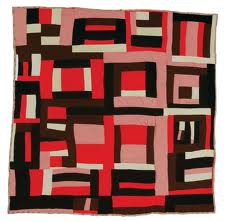
The women of Gee's Bend have been making quilts for generations. By definition, a quilt is made from recycled fabric and clothing items. Quilts are also an excellent medium for telling a family's story. These women have had their quilts exhibited all across the country, from major art museums to galleries in Seattle.
Listen to a story about these amazing artists on NPR, here.
Notice the relationships between the quilt on the pillow below.
Kuba cloth pillow
To see more images of Kuba cloth and to explore the similarities in design and patterns, click on this link. The Textile Museum in Washington, DC had a major exhibit of Kuba Textiles and Weaving. The book produced for the exhibit can be found on their website or through an Amazon banner at BlackPast.org (a portion of the sale will benefit BlackPast.org). The book is magnificent!

"Earth Skin" 2007 El Anatsui
This brings us to the artist El Anatsui, currently exhibiting at the Brooklyn Museum. He "converts found materials into a new type of media that lies between sculpture and painting, combining aesthetic traditions from his birth country, Ghana; his home in Nsukka, Nigeria; and the global history of abstraction." The New York Times art critics Holland Cotter and Karen Rosenberg both reviewed his show. The photographs at each of the above three links will take your breathe away!

Fabric from Ghana
Looking back and forth from each one of these photographs, it is impossible not to see a link, a lineage through time, geography,culture, and aesthetics. The patterns, colors, stories, possess a commonality but have been created in unique circumstance very far from each other, with different intended uses.  What will the next generation of artists take from what they have seen and learned? How will they recycle materials into objects of beauty? Objects of utility?

Saturday, February 16, 2013

Langston Hughes Performing Arts Institute: 40 Years of Black Performing Arts History in Seattle, Washington

Editor's note: today's blog post is written by guest blogger Lisa Myers Bulmash.

It is nice to point out heroes of color during Black History Month, like legendary poet/playwright/author Langston Hughes, but as readers of the Black Past blog well know, black history is something everyday people create, every day. For the past four decades, the Langston Hughes Performing Arts Institute (LHPAI) has created performing arts history vital to the Seattle African American and Diaspora community

Synagogue Bikur Cholim
The Institute seems to have always been part of the Central Area, and, in a way it has: its landmark building was originally erected as the Chevra Bikur Cholim congregation's synagogue and dedicated in 1915. At that time, the Central Area was a mostly Jewish neighborhood with some residents of black, Japanese, and Scandinavian heritage.
More black people began to move to Seattle during World War II, but were restricted to the Central Area by job and housing discrimination. It took long-term challenges from dozens of Seattle civil rights activists and thousands of demonstrators and protestors of all racial backgrounds in the 1960s for the city and state to improve housing, educational and recreational opportunities for blacks and other people of color.

By the late 1960s many of these activists, including most prominently Walter Hubbard, Jr., sought a chance to establish a cultural center in the Central Area.  That chance arrived in 1968. The congregation of Bikur Cholim sold its synagogue to the City of Seattle as many of its members migrated out of the area south to Seward Park and east to Mercer Island and other suburbs. In 1969 Walter Hundley and Seattle’s leading anti-poverty organization, the Central Area Motivation Project (CAMP) created an unusual partnership with the City of Seattle. CAMP utilized the City's federal urban renewal funding to help create the Langston Hughes Cultural Arts Center.

LHPAI exterior
The Center was managed by Seattle Parks and Recreation Department as an African American-focused community center.  Its founders however, had another purpose in mind; the Center would also be an arts organization that would serve as a venue for plays, poetry readings, and other performance art.  Then as now, the Center also offered art classes, hosted organizations like the Madrona Youth Theatre, and rented out its performance and meeting space. But there was always tension between the twin foci of the Center. One early Center advisor captured that tension when she described it as “a recreation center that does not do basketball.”
Montlake School, 1975

Despite these conundrums, by the early 1970s the Cultural Arts Center became the major force shaping Seattle's African American arts scene, cultivating and promoting numerous local performing artists. These performers included local actors Umeme and  Kibie Monie. The center also became a focal point for out-of-town talent who began arriving in the 1980's. Among these were Jacqueline Moscou who acted and directed in several productions and director Michelle Blackmon, who, in 1999, staged “Purlie Victorious” (by playwright and legendary actor Ossie Davis seen here with then-Executive Director Stephen Sneed).
Steve Sneed with Ossie Davis

In 2001, the Seattle Parks Department, recognizing the growing importance of the Cultural Arts Center’s role in the local performing arts scene, approved a reorganization plan to focus more strongly on this part its mission.  That reorganization included a name change to the “Langston Hughes Performing Arts Center.” This change brought in Jacqueline Moscou as its first artistic director. She staged several theatrical productions, including "Death of a Salesman" with an all-black cast in 2005. (This innovation was not repeated on a major scale until the 2009 Yale Repertory Theatre production, starring Charles Dutton). The new Center adopted a dance company-in-residence and started an artist-in-residence program. The Center also launched its annual film festival in 2003, expanding the event's duration from three to nine days in 2007.

The weight of all that history took a structural toll, forcing a building closure from 2010 to 2012 for seismic and electrical renovation. Since its reopening in 2012 as the Langston Hughes Performing Arts Institute (LHPAI), the organization has continued to offer authentic African American and Diaspora performing arts to all of Seattle. LHPAI transferred from the parks department to the Office of Arts and Culture in 2013 and has established a dance company-in-residence as well as an artist-in-residence program. Royal Alley-Barnes, LHPAI's executive director since 2009, increased infrastructure resources, community connections, and emphasis on the mission to ensure the focus on local and grassroots artists continues. The institute also offers winter and summer performing arts academies, ongoing educational opportunities, and a new website. This February marks the institute's first Black History Month back in its home of more than forty years, an occasion worth celebrating.  We invite all who are interested to come to the new Langston Hughes Performing Arts Institute.

Photo credits: Synagogue Bikur Cholim: WA State Jewish Historical Society; LHPAI exterior: Joe Mabel; Montlake School 1975: Langston Hughes Performing Arts Institute; Steve Sneed with Ossie Davis: LHPAI